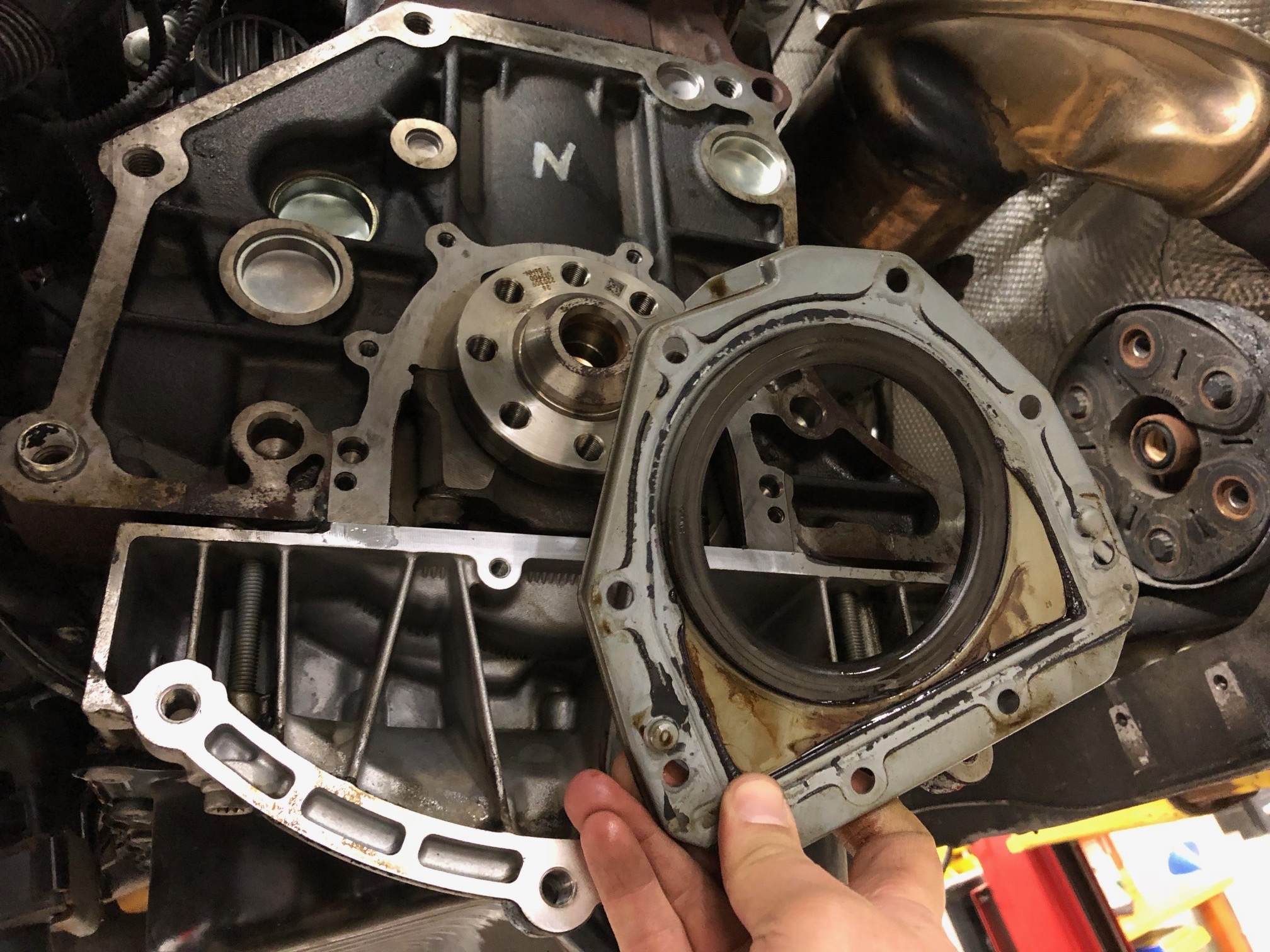
Another day, another job.
Today we present to you a somewhat common issue with 2009-2012 Volkswagen Tiguans, and that is failing rear main seals. Now, we say 2009-2012 VW Tiguans, but the issue can occur on any 2.0TSI Volkswagen, Audi or Porsche (2014+ Macan).
Common Symptoms:
Do you have a pesky oil leak that just won’t seem to go away? The leak can range from a couple drops on the driveway to a pool. In extreme cases, the MIL will illuminate due to a vacuum leak out the seal and you will be running lean.
Why?
The 2009+ TSI 2.0T’s were fitted with a poorly designed PCV valve. The effect of this is too much pressure building up in the crankcase, and the PCV isn’t venting it out correctly. When this happens, over time it causes the rear main seal to blow out and begin leaking. We have heard possibilities of this issue becoming prevalent due to the fact consumers are using incorrect spec oil, and fuel.
We have covered this topic in the past, if you want to view our post click here. We will be writing a post shortly on poor quality fuels being used and the effects that has on your Volkswagen / Audi.
What needs to be done?
Plain and simple, the vehicle needs to be inspected. When inspected, the vehicle is put on a hoist and the underbelly of the engine and transmission is inspected for oil residue. Normally when the rear main seal fails, there will be obvious oil buildup between the engine and transmission mating surface. In some cases the inspection may show alternate sources of oil leaks. However, if it is found that there is excessive oil residue pooling between the engine and transmission, it means your rear main seal has begun to fail.
Because of this issue with the PCV becoming so prevalent, VW has issued a redesign that resolves the issue at hand, but does not automatically fix, or prevent a pre-existing failed or failing rear main seal.
Whenever we replace a rear main seal, we always quote with replacing the PCV with the updated version (if it hasn’t been already), the rear main seal, and normally a full synthetic oil change with VW spec oil.
By doing this, all the bases are covered.
OK, OK, but how much is this going to cost me?
The updated rear main seal and PCV are relatively inexpensive, the rear main costing around $100, and the updated PCV costing $200. Unfortunately this is a labor intensive job, coming in a little over 7 hours.
Why you ask?
As mentioned above, the oil leak is always evident between the engine and transmission. This is because that’s where the rear main seal resides, thus the transmission needs to come out in order to replace it.
All in all, it does seem to be an intimidating issue. But with the main culprits having updated designs, this is not an issue to worry about once your vehicle has been repaired.
I hope you enjoyed this blog post, feel free to share it around if you want.
Thanks for reading.
Hey everyone!
Today our blog post is all about inexpensive oil filters, and the potential dangers of using them.
Lately, we have been seeing an influx of Volkswagen and Audi 2.0T’s (TSI’s) coming in with stretched chains, failed tensioners, or broken guide rails. This has become a common issue on VAG 2.0T TSI’s, and owners are having to shell out a fair amount of money when their timing chain fails.
What happens when my timing chain / tensioner / guide rails fail?
The timing chain’s main purpose is to ensure the bottom end of the engine is completely in sync with the top end. If a chain stretches, or a tensioner fails, or a guide breaks, that chain is no longer able to effectively keep the engine timed. When this occurs, the top and bottom end fall out of sync, causing the valves in the top end to be hit by the pistons in the bottom end.
When the pistons strike the valves severe damage can occur. We have seen minor bending in the valves, to complete destruction of the valves even being shot into the head. This will require either a complete head rebuild, or a head replacement.
This is clearly not good.
What is causing this issue?
In our experience, for the most part what we are seeing is (9.9 times out of 10) is people either using poor quality oil, or (this is the big one in this case), poor quality oil filters being used.
Timing chain systems rely so heavily on oil pressure. In operation, oil enters the oil filter through a series of small holes on the outer edge of the base flange. The oil is then directed through the filter, eventually making an exit into the engine through the large center hole. Most modern oil filters are equipped with an anti-drain-back valve. This is often some form of rubber membrane that covers the perimeter holes in the base flange. The membrane is forced aside as oil enters the filter case. When the engine is not running, the rubber membrane covers the holes. Obviously, the anti-drain-back valves maintain oil within the filter. In turn, they prevent engine dry starts (when the engine is started with no oil).
Many inexpensive off the shelf filters do not have this membrane, or check valve to keep oil inside of them. There are many oil filter brands that we avoid at all cost, always preferring the OEM filters, or companies that make the filters for the manufacturer.
For example, Audi and Volkswagen filters are made by either Mann, Mahle, and other manufacturers will have their filters made by Hengst, Motorcraft, and others.
Every time we see a Volkswagen or Audi come in with a failed engine, the first thing we check is the oil filter. This past year we have seen a fair amount of VW’s and Audi’s requiring a chain replacement, and all of them had a cheap filter.
A key point to keep in mind is you get what you pay for. Why can you spend up to $100+ on an oil change, whereas the place across the street from you can do an oil change for $30?
Inexpensive materials. Volkswagen and Audi’s require full synthetic oil for the longevity of the vehicle. Most Quickie-Drain-N-Lube shops will either use regular, or synthetic blended oil, and a very inexpensive oil filter.
We get it. We all want to save money. If you have the choice to spend $30 over $100 most of us would pick the more economical option. In this case, the old adage proves to be true: Save now, spend later.
Your vehicle is an investment and you want it to last as long as possible.
What can I do?
We cannot overstate the point to have your vehicle serviced by either the dealer, or a trusted repair shop. At Euromotive, we only use the best oil (Full Synthetic VW/Audi Spec, imported from France), and OEM filters.
What if you want to do your own oil changes? That we understand too, we all love to wrench on our own cars. If this is the case, purchase quality materials.
Ensure you use correct VW/Audi spec oil. These vehicles are very particular when it comes to the oil and filters you use, so do take care that whoever is doing your oil changes they are using the good stuff.
Entrust your vehicle with Euromotive, we only use OEM parts and fluids for your vehicle. Give us a call today!
Hey everyone!
We have been getting a lot of phone calls and customers coming in asking about their 2009-2012 Audi 2.0T’s burning a lot of oil. That’s why we are going to provide you with this post today, to fill you in on what’s the issue, and what Audi is, or isn’t doing about it.
The Problem
Many 2009-2012 Audi 2.0T (The A3’s are not affected) engines are experiencing moderate to severe oil consumption. The main issue with these engines seems to boil down to the piston rings, which allow small amounts of oil to pass the pistons and be burnt off.
When this begins to happen, lots of customers frequently get an oil level low warning. When this does appear on your dashboard, tend to it quickly, and only top up your vehicle with the correct spec of synthetic oil. Not cheap Walmart or Canadian Tire bargain oil.
In more severe cases, another sign of this issue is noticeable, excessive smoke coming from the exhaust upon acceleration. There can also at this stage be scoring on the cylinder walls, causing more oil to seep past the pistons.
Now, Audi actually states that your vehicle burning a litre / quart of oil per 1000km is perfectly normal. Totally within spec. In fact, it’s even written in your owners manual to expect this kind of consumption.
Do I have the issue?
One way to truly see if you have a consumption issue is by actually tracking the mileage you do between having to top up your oil. Simply do this by resetting your trip monitor when you top up your oil, or by noting the mileage when you top up.
When the message comes up again, calculate the mileage you have done before having to top up. If you’ve done less than 1000km you probably have an issue. Really, even if you are less than 2000km you probably have an issue. Unfortunately, Audi won’t admit an issue until it’s below 1000km.
What to do?
Unfortunately the only way to actually see if you have a problem, is taking it to the dealer. The process involves the dealership draining your oil, then carefully adding a measured volume of oil. They will get you to then drive the car for a set amount of mileage, or before if the add oil light comes on. Once that occurs, you bring the car back to the dealership and they will drain the oil, and measure it out to see how much you actually used.
If more than half a litre has been used, you have failed the test and Audi will discuss repair options with you. DO NOT TOP UP YOUR OIL DURING THIS TEST. It will throw off the test.
Now, we have heard conflicting stories about the actual cost of this test. From some, we’ve heard they only charge you the cost of an oil change, others have been charged around the $700 mark, as Audi will change the oil separator and some other updated parts, and some have reportedly had the test done under goodwill.
OK, I have an issue, how do I get it fixed?
There are a few resolutions to this issue, all of which are not cheap. To fix this oil consumption issue involves essentially a complete engine rebuild. Again the issue is the oil rings on the pistons are too shallow, causing oil to build up too quickly in the rings to the point it just seeps past the ring and gets into the compression chamber, burning it off. The updated design for these rings are much deeper, allowing more oil to be caught and scraped off the cylinder walls.
You have to tear the engine down, remove the pistons, and inspect the cylinder walls for damage. If there is no damage, new pistons and connecting rods are installed, as well as new rod bearings, head gasket, and other hardware.
This job will cost in the ball park of $6,000 once everything is all said and done.
Woah! I can’t afford that! Can’t I just keep driving it?
Technically yes you can continue to drive it in it’s current condition for a limited time. Keep in mind though you must stay on top of your oil, constantly topping it up and ensuring it’s at the correct level.
On the other hand, continually driving the vehicle in poor health can cause damage to it, and eventually cause complete engine failure.
And what does Audi have to say about this?
Initially, not much. However, Audi has released a settlement for this issue, but only if you are within 8 years, or 140,000km, Audi will completely cover the cost of the rebuild.
Now, again we have heard differing stories about this. There have been some customers slightly over the allotted mileage, and Audi has covered the repair. Others have been 500km over the allotted mileage and have gotten nothing.
This is something that is up to the dealer’s discretion at first. If they decline a repair, call Audi of Canada or Audi of America if you are in the states.
There are some stipulations of the warranty program, including having complete Audi service records, the vehicle has not been modified etc.
So what you’re saying is I should avoid buying these vehicles?
Not really, these can be excellent cars, in good, and well serviced condition. However, many people realized there is this big issue with these cars and are desperately trying to offload them to unsuspecting buyers.
If you are looking to purchase an ’09-’12 A4, A5 or Q5, do your due diligence and request service records. If the customer has complete service records from Audi and you can tell the vehicle has been very well maintained, still be upfront and ask. Does this car have consumption issues?
If you can find one that has already been repaired, great. If not, be prepared to potentially spend $6,000 on an engine rebuild. Which if the vehicle is purchased for a low enough price and the mileage is good, you could potentially still come out ahead of the game.
This has just been an informational blog post, and hopefully it helps people out. If you do end up having this consumption issue, let Euromotive help you out. We have done a few of these jobs already and have completely satisfied customers.
Thank you for reading.
Actual intake manifold may differ from photo shown.
Starting July 17 2017, until the 31st, HPA Motorsports is selling their Performance Intake Manifold for 2.0T motors.
Sale price is only $1,120.00 + tax (installation extra).
This Sunday we will be set up at the 2017 June Jitterbug event at Fireman’s Park in Niagara Falls!
The June Jitter Bug has grown over the years into becoming one of Ontario’s Largest VW shows. With show car attendance peaking over 350, its hard to view all of the cars displayed. In a park setting with plenty of shade, a playground, hiking trails and close to factory outlet shopping malls, it makes for a great day for the whole family.
Swing by our booth to say hello! We are going to be having some great promotions on products and services we offer.