Can we all just agree that this winter has been a terrible one? From the extreme fluctuations in temperatures, to the excessive amounts of snow that we have received, this winter has no doubt tested everyone’s sanity. Don’t fret! The end is in sight, it’s mid-March and the light is at the end of the tunnel (knock on wood).
That being said, with the extreme temperature fluctuations, tonnes of salt and brine being thrown down, and constant plowing, the roads have taken quite the beating.
Pot holes, everywhere.
Even on the highway, you’re cruising along peacefully, when all the sudden, boom. Some of them are completely unavoidable, no matter how hard you try to swerve out of the way.
That’s why we here at Euromotive Auto Service are offering a complimentary, post-winter inspection. Our suspensions, tires, wheels, and brakes have taken quite a beating this year.
Now that the nice weather is here, and we are all planning road trips or beach days, let’s make sure that your car is driving smooth and straight, the way the manufacturer intended. Plus, who wants to have a car load of friends and your car is knocking over bumps, or you’re driving straight but the steering wheel is at a 45 degree angle? Not me.
Trust Euromotive Auto Service to make sure your vehicle is in tip top shape. Book your complimentary inspection service with us today!
The day we found it
The day is May 31, 2018. We are dropping a customer’s car off at their house, and we stumble upon a VW fan’s paradise.
5 Classic Volkswagen’s parked in a driveway a few houses down. They looked a little tired, and could use a really good cleaning and restoration. We approached the homeowner to see what his plan is for the vehicles.
His first words: “Which one?”
We get to talking, and he proceeds to tell us he had these vehicles stored for approximately 30 years in a barn. The barn was changing ownership and he had to get them out of the barn as soon as possible.
Steve bee-lined on the Black 1959 Bug sitting in the driveway. Miguel fell in love with the 1974 Super Beetle Pickup behind the Karman in the picture above, that is another story.
We both make the owner an offer right on the spot, and he graciously accepted. We got there in the nick of time, as he had multiple people arrive that day making him offers for the whole lot. He was kind enough to say he had another offer.
Bringing it home.
The day it was towed into the shop
Now that the vehicle has arrived at our shop, it allowed us to perform a complete inspection. Aside from a thick layer of dirt, it was in great shape.
Being stored in a barn for ~30 years had been gentle on these cars, with no weathering of the paint, and very little patina. We then washed it down to see what we were truly working with. Unbelievably, a decent paint under the layer of grime. We discovered it was a fresh repaint before it went into storage, which was a big bonus.
We used a hearty cutting compound to cut through the over 30 years of crust that built up on the chrome and paint
It was then we got to working on polishing the paint and the chrome to make it shine. Now, time for the mechanical.
All nicely cleaned, and polished
Having sat for around 30 years, we knew what needed to be done first to get the Bug started. We pulled the tank out and cleaned out the varnish. After flushing the tank multiple times, we got it all clean, and topped it off with a fresh tank of brand new fuel.
Before we flushed out the fuel
Next on the agenda was to replace the two fuel filters. We wanted the fuel to be as filtered as possible, so we got 2 OEM Bosch fuel filters and replaced the old, grungy filters. After this was done, we turned the key.
She sputtered to life, and sounded very healthy! She ran and idled beautifully, no chugging or stalling. It was time now to inspect the brakes, and lines.
Now it’s running, can it stop?
Time to take all the brakes apart and inspect the drums, shoes and all the lines. When we took the drums apart, we discovered this car was in need of at the very least, wheel cylinders all around as they had been sitting dry for the duration of its storage.
The moment we took the brakes apart
Then we made a list and jumped on Cip1.ca, a great source for all classic VW parts, and they’re located in Canada! We ordered brake drums, shoes, wheel cylinders and all associated hardware as well as lines. We also picked up some random bits here and there, including a new set of carpets for the interior of the Bug.
All new brakes
The new brakes are looking nice, and will ensure the Bug will be able to brake as effectively as VW originally intended. We then decided it was time to change out the old crusty wiring, and replace it with a new, complete wiring harness.
Old wiring
New wiring all laid out, ready to be installed
Now that all the wiring has been replaced, we attacked some minor cosmetic things like replacing all the carpeting, painting the interior of the front trunk.
Exterior Work
After all the mechanical work was done, including an engine refresh, oil change and tune up, we moved on to the exterior.
A new set of white-wall tires were ordered from Coker Tire in the states. Before installing the new tires, we stripped the old tires from the rim and had them sand blasted and painted the outer rim a high gloss black to match the body paint, and the centers a high gloss white.
With the wheels looking like new, we could then mount and balance the new tires. The white walls really added a classic look to the VW!
We then tidied up some more exterior and interior bits, and now it’s all done!
The Finished Product
After many hours of hard work, the Bug is finished, and for sale. If interested, please send us an email through our contact form, and we will get back to you as soon as possible.
Thank you for following the build, we hope you enjoyed it!
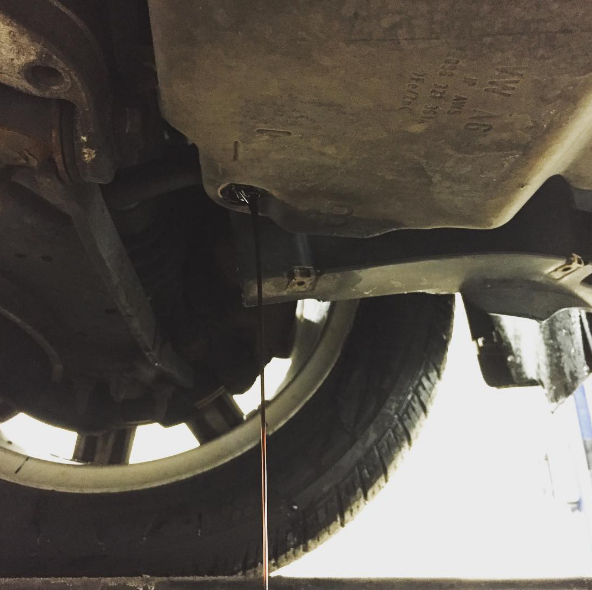
Many people seem to be confused. 5k, 8k, 10k… How often should I change my oil??
This is a very good question, and one that we get asked quite often. Oil and engine technology has come a long way in the recent years.
Some people are still living by the 5,000km oil change interval regardless of the oil they are using. So, let’s discuss oil change intervals, and why you could be wasting your money.
What the Manufacturers Recommend
If you are going to a reputable source for your oil and lube services (we are repudiating 10 minute quickie quickie oil change locations), they will be using the correct spec oil that your vehicle requires.
The majority of manufacturers recommend between 8-20,000km oil change intervals. The manufacturers have studied their vehicles, put them through rigorous testing and whatever mileage they set for their vehicles is what they conclude to be a “good” interval.
What’s Commonplace
We have seen many people either closely adhere to the service sticker on their windshield, or stick to a pre-conceived interval they have been changing their oil at for ages and nothing has gone wrong.
We have also seen instances of people ignoring oil service completely, and, well, let’s not discuss that right now…
What We’ve Found
In our experience, we have used high-quality, European oils such as Total, and Liquimoly (Liquimoly now being our preferred brand), and we have experimented with our own vehicles as to what the best interval is. That being said, we are testing on Volkswagen’s and Audi’s, but this goes well with pretty well any vehicle brand.
We have pushed the limits of the “recommended service interval”, and have found that, in the case of VW and Audi, it’s simply too long.
In our experience, we believe we have found a sweet spot (Again, for VAG vehicles). 10,000km*. Why you ask?
*For Non-VAG vehicles if this exceeds the recommended interval, DO NOT EXCEED
With modern filters and oils, 10,000km seems to be a perfect medium, where the oil still has life in it, and, most importantly, the filter is still healthy.
We have previously posted about filters, so we won’t get into extreme detail. If filters are left too long, the filtrate material either begins to clog, loosing its effectiveness, or the material begins to constrict, reducing filtration capability. If left too long, even high quality OEM filters, the filter will not be able to perform as effectively as before, and could allow contaminates into your engine.
Contaminates are no good for your engine, and can lead to premature wear and tear, and engine failure. Another issue with constricted filters, is a reduction of flow, reducing the effectiveness of your lubrication system, causing it stress, and of course eventual failure.
This is speaking of course of high quality synthetic oils. What if you are using non-synthetic oil?
We recommend 5,000km for best results. Again, if this exceeds the manufacturers interval, do not go beyond the recommendation.
TL:DR Version
To summarize, we recommend following the manufacturers specified service interval. In our experience, we find the 10k+ intervals too high. 10k seems to be a great medium for oil changes (with full synthetic, non synthetic 5k), the oil still has life in it, and the filters aren’t restricted and are still able to filter effectively. Also, if you are unable to reach a service station right at that 10k mark, you still have some life in the oil and filter.
This is simply what we have found. There is nothing wrong with changing your oil a little earlier than the manufacturer recommends. There is also nothing wrong with changing your oil at the specified service interval. Mainly, what we want to stress is never go over. Waiting too long for an oil change can lead to sludge, and engine failure.
We have been having a lot of people asking us, “Steve, do I really have to put premium gas in my Volkswagen?” (or Audi, or BMW, or anything German or has a turbo, or is direct injected).
“It costs too much”. This is the most common complaint of having to put premium fuel in your vehicle. If you drive a premium vehicle, or a sporty vehicle (GTI, Golf R, WRX, Focus RS etc…), you paid a higher price for a better vehicle. Performance, build quality, and more are all a by-product of owning a premium product. There are many people who can afford such a vehicle, but cannot afford (or choose to cheap out on) the regular upkeep of such a vehicle.
The big one is fuel. OK, it costs more than regular fuel. But consider this: at the time this was posted, according to GasBuddy.com, the current price of regular gas is 120.9¢ / l. The current price for premium fuel is 139.9¢ / l. It looks much higher! Let’s factor in the average vehicle has a fuel tank capacity of around 55 liters (Usually 50 + a 5 liter reserve), so to fill your vehicle with regular fuel you would be looking at $66.49. For premium, you would only be looking at $76.94, a difference of only $10.45. It’s not that bad.
Especially when you consider the good effects premium fuel has on your vehicle. Premium fuel has a higher octane rating which causes your vehicle to run more efficiently, and cleaner. Not only that, but premium fuels have a higher detergent rating than regular fuels.
A study by AAA compared valves from a vehicle running regular (or non-top tier) to one running premium (top tier). The results according to AAA were “surprising”. The vehicle running premium fuel saw on average, 19x less carbon buildup on the valves then that of the vehicle running regular fuel. The photo can be seen below.
Image Credit: AAA
What this means for your vehicle:
When your vehicle is running more efficient, it runs cleaner. Modern vehicles are all switching to direct injection systems. Pretty well all manufacturers are doing it, Ford has recently done it with the Ecoboost motors, Mitsubishi was one of the first mainstream vehicles trademarking GDI, Volkswagen has been doing it for many years, Subaru has recently switched to it, and more. The reason for going direct injection is simple, more power, less fuel consumption.
That’s why now you will see a big Ford Escape with a small 1.6l turbo. You have the power, and the fuel efficiency to move around an SUV. This is great. The only drawback of direct injection is you don’t have fuel cleaning the ports because fuel is being injected directly into the combustion chamber.
Carbon begins to build up in the valves and can cause driveability issues. With a higher quality fuel, and more detergents in the fuel it reduces this buildup.
If carbon deposits get out of hand, the vehicle will start to run poorly.
We do have a chemical-based removal which proves extremely effective, but if the deposits are so bad, the intake manifold has to come off and be cleaned by hand. Which can be quite expensive.
Very heavy carbon deposits
BG 44K Carbon Clean Service
So is it worth putting Premium fuel in your vehicle?
Refer to the manufacturer. Pop open your fuel tank door and see what they recommend. If it says “Requires Premium Fuel” (which most turbo, or direct injection vehicles do), then you must use Premium. If you don’t, you will experience pinging or pre-detonation occurring, which could prove detrimental to your engine.
If your vehicle isn’t direct injection you can get away with using regular fuel. Sadly, most manufacturers recommend regular fuel and oils in their turbocharged, direct injection vehicles. This is where we see a lot of issues.
These issues range from carbon buildup, to random driveability issues, to engine failures.
While the cost of Synthetic oils and Premium fuels may be a little bit more, it more than saves you headaches in the end. Save a penny, spend a dollar.
That’s all for today!
Thanks for reading, and be sure to share this blog post.
Do you hear a noise?
Category: Mechanic Service, Restoration
Don’t ignore those little noises. Usually simple, small fixes can turn into large and extensive repairs.
In this case, the issue was caught before any serious damage occurred. It could have been a lot worse.
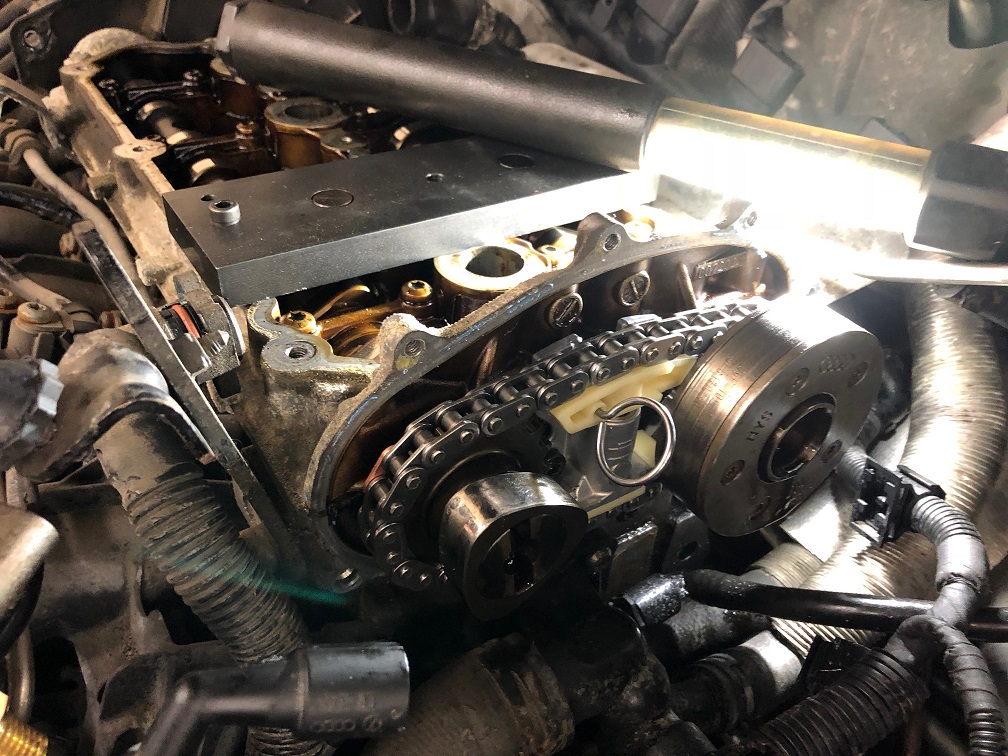
The customer brought their vehicle in with a slight noise coming from the vehicle, almost un-noticeable. Upon inspection, we found the cam chain tensioner had begun to weaken, and wasn’t holding the chain tight enough. The effects of such you can see in the image below, the chain began scoring the adjuster housing.
With a new chain, and adjuster the vehicle will be all good to go.
Do you have a noise coming from your car?
Let us check it out, all makes and models welcome!
(905) 684-3876